

This month we are looking at how you can enhance your prospect research and make sure you are spending your time approaching the most relevant funding organisations for your projects.
What’s the problem?
At The Charity Spark we are keen to ensure your precious time is used as effectively and efficiently as possible. We had a conversation with a client recently where they shared their disappointment at ‘only’ being awarded £5000 from a trust funder when they had written to the funder sharing their project deficit was around £80k.
‘What is their average gift? And what size donation do they invite bids for?” we asked, our client didn’t know. A few minutes research showed that the funder in question gives out gifts in the region of £2k-25k and a review of our client’s application showed they hadn’t actually asked for a specific amount at all. Overall, we encouraged them to see £5k as an absolute win all things considered and we helped them to structure their research so that they could manage their expectations better in the future.
Tip: Use the Charity Commission annual reports to refine your prospect research and grant asks.
Many trusts have very helpful funding guidelines on their website so that is always the first place to go when researching potential funders for your organisation. My ‘second fix’ research is to go to the Charity Commission website and search for the funder there.
Once you’ve identified their record, take the time to read their most recent annual accounts. Most funders include a breakdown (some more detailed than others!) of where they have donated during the past year.
Some funders break this down by value e.g. grants over £10k, over £25k.
Some detail every recipient organisation by name.
Some specify the area of charitable work and how much money has been granted to organisations working in that area e.g. Refugee Support Services – £100k to 15 organisations.
It really varies and there is no proforma however it is always a useful place to use as a benchmark. By knowing how much the average grant is, you can more realistically adjust your own grant application to reflect a typical grant size. Additionally, it can provide helpful insight into what types of organisations the funder is donating to, sometimes this can clarify their charitable objectives which can be rather vague.
This research tool is also very useful for trusts who may not have a website and so offer very little information about grants that they make.
Here is a screenshot of page 16 from the Lennox Hannay Charitable Trust who don’t have a website but who do fund a wide range of charitable causes.
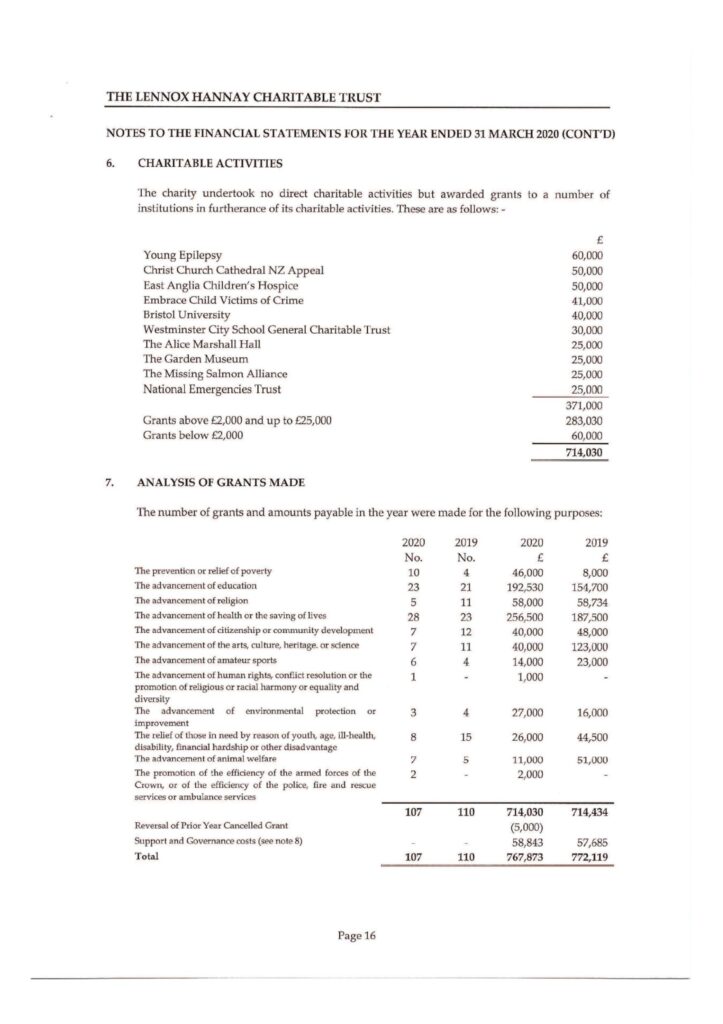
You can see here that they made 10 large grants over £25,000 but state that they gave 197 grants in total during 2020. They also share that excepting the 10 large grants, they made £283,030 in grants between £2000-25,000, and £60,000 in grants under £2000.
In broad brush strokes, we can glean from this that the average grant is £3536 (97 grants under £25,000 totalling £343,030). This information should guide any application to the trust unless you received further guidance from the trustees. We expect that the 10 larger grants had an existing relationship with the trust.
We hope this research tool is helpful to you whilst refining your prospect list. Do let us know if you start delving into the charity commission records, it is one of our favourite parts of research!
