
Cultural anthropologist Margaret Mead worked on a number of fascinating cultural theories and often commented on women’s rights, nuclear proliferation, race relations, environmental pollution, and world hunger. An interesting lady, no?
It is also reported that she was once asked by a student what the earliest example of human civilisation was, perhaps the student expected talk of clay pots, tools, evidence of religion or cooking equipment. Margaret said that she felt the first evidence of civilisation came from a skeleton thought to be dated 15,000 years old (since Margaret’s death, this skeleton has been re-dated as 13,000 years old). The person’s femur had been fractured but then healed. It takes around six weeks of rest for a femur to heal. In the animal world, you would die if you could not move to get water, hunt for food or to escape danger. A broken femur which had healed, Margaret commented, was evidence that there was someone caring for the injured person. Someone had stayed with them, kept them safe, fed them and ensured they were recovering. A healed femur indicates a society that values caring for one another.
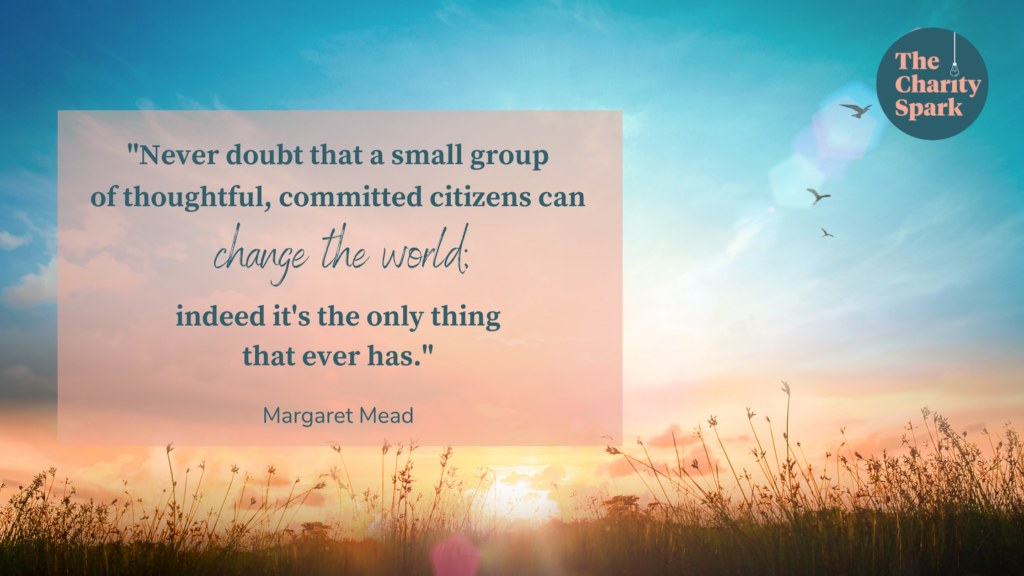
“Helping someone else through difficulty is where civilisation starts,” Margaret Mead said, “Never doubt that a small group of thoughtful, committed citizens can change the world; For, indeed, that’s all who ever have.”
From the history books to the present day, charity has been present in our societies for as long as we have had communities. In the UK, the first recorded charitable organisations date back to the 6th Century when The King’s School, Canterbury was established in the year 597AD. For thousands of years, schools and religious organisations provided much of the charitable activity in the UK and around the world. They were the hospitals, the almshouses (low-cost charitable housing), provided home and education to orphans from the poorest families, and food to those in their community who had nothing.
Today we see charities and not-for-profits still fulfilling many of these roles in our communities. As we’ve seen the numbers of charities grow over the years, we’ve also seen a huge increase in the number of causes they are set up to support. From humanitarian organisations both in the UK and abroad, to vaccination programmes, lobbying and advocacy, care for animals, support to military veterans, to single parents, to the elderly and so many more.
There are over 169,000 registered charities in England and Wales but closer to 500,000 charities and not-for-profits including those exempt from registering and those registered in the other home nations across the UK (reference: Charity Excellence Framework)
“Helping someone else through difficulty is where civilisation starts,”
Margaret Mead
So why do we love working with charities and not-for-profits?
The reason I started this blog with the anecdote about civilisation is key to why I love working in the charity sector. It is why I have built a team around me who share a mutual desire to make a difference, sparking change with the work we feel privileged to do.
Every single charity has been established to solve a problem that is causing hurt, suffering, injustice or fear for someone.
Every single charity wishes it didn’t have to exist. Every single charity in the UK seeks a day where their beneficiaries don’t need them!
Every single charity is trying to make their community, wherever that is and whoever it is made up of, a better place.
Everyone will be able to name at least one charity that they, or someone they know, have been supported by in some way or have been able to gain help through, maybe even for the animals in their care.
Now THAT is an amazing group of people to be able to collaborate with!
Charity People
We never cease to be amazed by the passion we find in the charity sector. Whether through staff members, volunteers or those they exist to support; we can always guarantee an amazing energy for what they do.
We love to support charities and not-for-profits to reach MORE of those they support and to plan for a future in which they can reach as many people as they need to in order to alleviate suffering, improve lives and change the world.
This might all seem quite like hyperbole but we hope that it is actually a celebration of the history and importance of charities in our communities.
Just this year we have worked with organisations who are:
- Teaching inclusive communication techniques and advocating for those who have communication and understanding difficulties.
- Supporting people who are rough sleeping or are vulnerably housed with immediate welfare needs as well as a path back to employment and more sustainable housing.
- Raising aspirations in young people and improving attainment in STEM subjects as well as improving awareness of STEM careers.
- Empowering generations of young people in Lambeth, some of whom are at risk of gang involvement, through youth work, creative activities, sport and a listening ear.
- Improving the mental health of young men through football.
- Supporting hard-to-reach communities in Cardiff and South Wales with friendship groups, reducing social isolation and employability skills through a new, exciting church plant.
It is a privilege to work with people who are working in so many different ways to improve the society around them and we value working alongside those doing this work so we can help them to build sustainable futures to ensure they can continue to bring hope for years to come.
How do we help?
We work with charities and not-for-profits to provide advice, help and practical input in Impact Measurement and Fundraising from strategy, practical tools, team development and ‘on the ground’ bid-writing (plus a lot else in between!).
If we can help you to spark change in your organisation then take a look at how we could help or get in touch with us for a free consultation.
