

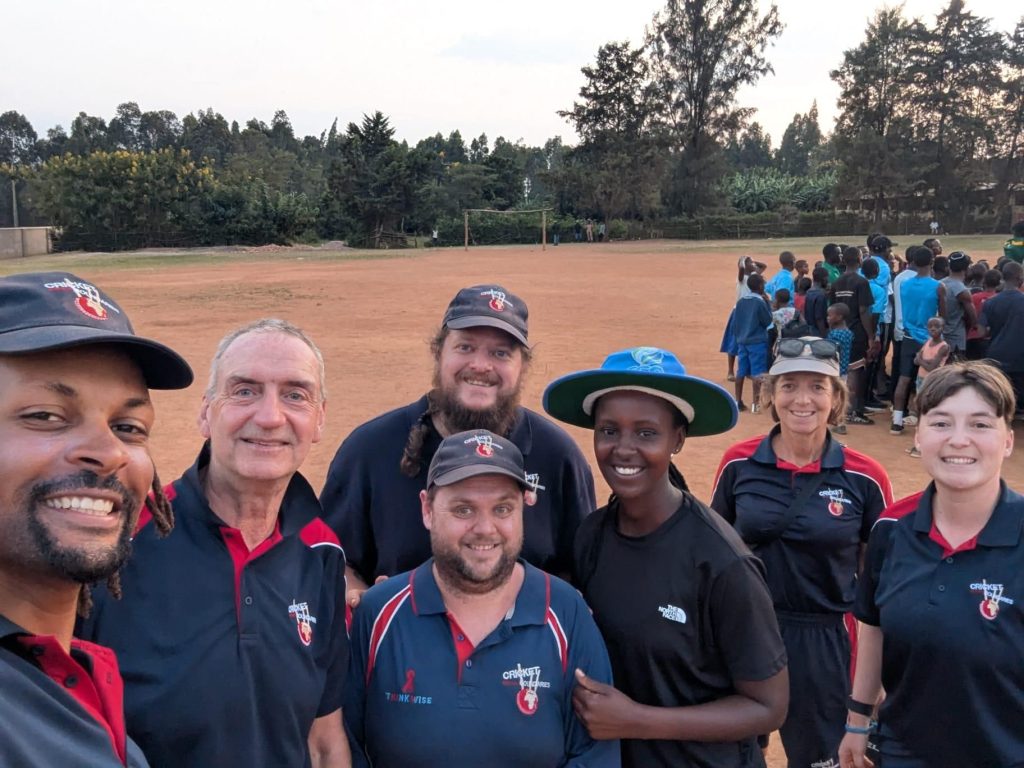
To mark Volunteers’ Week 2025, we’re celebrating the remarkable efforts of our own Research and Evaluation Officer, Dan, who took on an unforgettable volunteer trip to Rwanda with the charity Cricket Without Boundaries (CWB) earlier this year.
What began as a spontaneous application over a decade ago has turned into a 12-year journey of cricket-fuelled social change and cross-cultural connection. On this latest trip, Dan stepped up as project leader, guiding a team of new and seasoned volunteers through coaching nearly 5,000 children across 18 schools.
We asked Dan to reflect on his journey, from the inspiration to get involved, to the chaos of coordinating mass coaching sessions, to the quiet, powerful moments that made it all worthwhile.
“Do something, do anything—but don’t do nothing. You won’t regret it.”
Clive Hawthorn, Volunteer, Kenya 2014
Read on to discover how cricket became a catalyst for connection, confidence, and change not just for the children and schools CWB works with, but for the volunteers themselves.

What inspired you to volunteer with Cricket Without Boundaries?
I couldn’t tell you exactly why I applied back then but broadly-a combination of loving travel and cricket, combined with wanting to give back. I applied on a whim and was invited to an interview in Birmingham. A seven and a half hour round trip later and I’m still involved 12 years on!
Tell us about the work CWB do.
CWB uses cricket as a vehicle for delivering social change. The charity works in various countries across the world, and currently run projects for UK-based volunteers to four countries-Kenya, Uganda, Rwanda, and Nepal.
This autumn CWB are celebrating their 20th anniversary. It started with 3 friends and an ambition to play cricket from Cairo to Cape Town. At the time, they saw how much of an issue HIV and AIDS in sub-Saharan Africa was and wanted to do something to help address this, using cricket as a platform. As antiretroviral treatment has become more widely available, the charity has pivoted from focusing solely on this, to focusing on a broader array of health and social messages.
CWB seek to deliver change related to a variety of topics in the both the health and the social space. For example, the work undertaken in Nepal focuses on gender equality. The themes and topics we seek to address are tailored to the needs of the local communities.
What would you like to have known that you didn’t before first volunteering with CWB?
It’s hard for me to answer this as it was so long ago so I spoke to my team to get their insights. Five of the team were first-time volunteers and here’s some of what they told me:
- Be prepared to embrace the chaos-nothing can really prepare you for it!
- Don’t be afraid to stop and start again. We aren’t striving for perfection
- Conserve your energy
- The cricket is secondary-both in terms of what we do, and what you bring as a volunteer
- The messaging we deliver in and around sessions is more important than the cricket. In the case of the 2025 project, the messaging we delivered centred on cricket values-things we can learn from cricket that apply elsewhere in our lives, such as respect, teamwork, leadership, inclusion, equality, and most importantly-fun!
- As a volunteer, it matters far more that you’re enthusiastic, willing to get stuck in and be a good team player than whether you are a good cricketer or a qualified coach
- The most important factor that will determine how much you will enjoy the trip is your team. Like cricket-it’s a team sport and you will have times where you feel a bit down or exhausted, and that’s when your teammates step up. You in turn will ultimately do the same during the course of the trip
- Your voice matters and your opinion is valid. Make sure yours is heard
- It’s your time you are giving up-look after yourself and have fun-it’s infectious
You coached 4,994 children across 18 schools—how did you manage such a large and varied programme?
The short answer is you don’t manage it-you plan as best you can and adapt. Truthfully, you’ll nearly always be adjusting your well-made plan within 15 minutes of arrival. It becomes easier as the trip goes on as the team gel more and grow in confidence.
Managing the team’s energy levels is super important. You’re coaching in 30+ degree heat throughout the day and energy levels do fluctuate. We pair up wherever possible so that you could lean on one another, and alternate who leads each session, then you switch over.
The day-to-day sessions do differ, but the core skills we are delivering don’t change-batting, bowling, throwing, catching. Also, the messaging is consistent throughout the trip. CWB run a training weekend ahead of the trips which equip you with the skills to deliver the coaching and incorporate the messaging.
Acknowledging that even the hardest sessions that didn’t go to plan still have positive elements, we tried to learn from what didn’t work but also take those positives. The bottom line is, as long as the session was fun, safe, and inclusive-you did just fine on the cricket front.
How did the working with local coaches shape your sessions and experience?
The local coaches are invaluable to the work CWB does. They shape the sessions, translate for us when needed, and serve as our primary liaison with the school. They are full members of the team, as is the driver who gets us from school to school.
You can also learn a lot about the local culture by speaking to them, and they are incredibly generous. The coach we worked with most on this trip very kindly took us to his home for lunch, where we got to meet his family. This was a highlight of the trip-and the kind of moment you would never experience as a tourist.
Was there a moment that really stood out to you?
There were so many highlights on this particular trip. Often the most memorable moments happen around the edges of sessions, that you notice more on reflection.
If I had to pick one aside from the visit I’ve just mentioned, I’d probably go with the celebrations at our first festival. On a typical 2-week trip, teams cover three different locations and the last day before we move on is spent running a festival. Each school we visit brings along teams of ten, and we run mini games. The team that won the secondary competition happened to be the school hosting the festival-they were enthusiastic about winning-to put it mildly!
Other highlights/moments include:
- Working with a recently qualified teacher who took to cricket with a natural ease
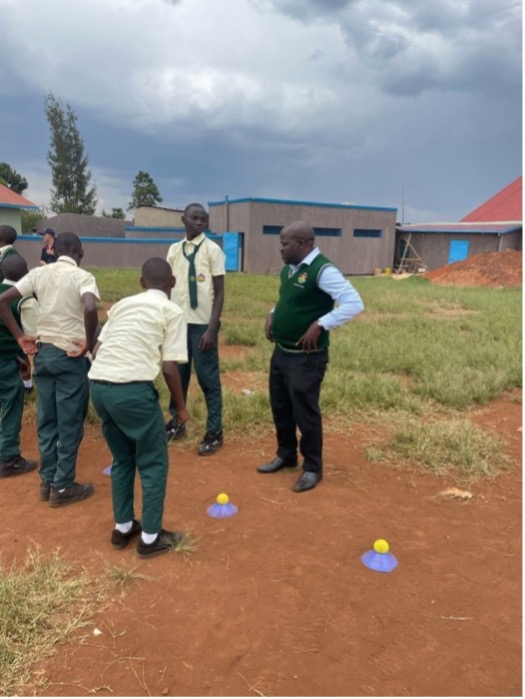
- Visiting a school CWB has been to before, and getting the headteacher to join in one of our gamesPlanting a tree at a school in the district of Nyagatare to commemorate bringing cricket to the region
- Seeing my new volunteers, who all had varying degrees of coaching experience, develop and grow as the trip went on
Did you face any challenges during the trip? How did you deal with them?
Every trip has some degree of challenge, but I felt very fortunate to have the team I did for my first trip as project leader. The team took everything in their stride. Some of our challenges included ratio of coaches to children, school activities such as unexpected exams meaning the number of children available to coach was reduced. Illness among the volunteers is also inevitable on a trip like this. But we were flexible and adapted and managed to make it work!
What skills or knowledge have you developed through volunteering with CWB that you are now finding useful elsewhere?
It’s helped me develop various skills. The easy answer to this is adaptability. It’s the most crucial skill that any volunteer can bring, or learn along the way. It’s also something that you can apply in so many settings. I’m naturally quite adaptable but my volunteering on projects with CWB has definitely helped me improve this. Volunteering on projects has also made me a more confident public speaker.
I’ve learnt from my work with CWB outside of the trips as well, I interview prospective volunteers on a regular basis which has obvious crossover benefits. Directly linked to my line of work-I get to see how Sara Begg, the charity’s Director of Impact, uses creative and participatory methods. I can take lessons from this and consider how to apply them in my day-to-day work.
This most recent trip allowed me to have a go at leading a team formally for the first time. I’ve informally led in countless settings, but this was the first time that I’ve taken leadership on officially.
Slightly counterintuitively, it’s made me LESS organised, or at least less concerned about perfection. One of my returning volunteers gave me some informal feedback that I might benefit from letting things just happen/go with the flow. I’m not totally sure I achieved this on the trip but it’s something I’ve definitely taken on board!
What have you learned about yourself from the experience?
That I’m likely a more capable leader than I would give myself credit for, even if I don’t consider myself to be the most natural
What advice would you give to someone looking to volunteer overseas?
Be sure to pick an opportunity that suits you, your passions, your interests, and the causes you care about. It’s a lot of investment in terms of time and money, but it is incredibly rewarding.
Be realistic about the impact you expect to have. You can’t change the lives of everyone you encounter but you might have a massive impact on a few people you meet along the way.
I typically pick volunteering opportunities where I can add value through the skills I have, or because I can learn something new and relevant through them. I find these opportunities more beneficial.
Would you do another trip with CWB? Why or why not?
Of course! The question is when. This trip was my fourth and I don’t plan on it being my last. It’s tiring but great fun and immensely rewarding. As project leader, it was especially pleasing to see how the team developed.
Many CWB volunteers come back and say that the trip is one of the best things, if not the best thing they’ve ever done-and I would agree with this. In an ideal world, I’d love to do another trip next spring but it might be further down the line.
