
Edit: this blog has been updated to remove the word ‘stakeholder’. To find out why we are actively removing this word from our work please read: Words Matter: why we’re changing the phrases we use.
We’ve talked in previous blogs about co-creation and the benefits it brings to your charity, organisation, and projects. Sometimes we forget about the importance of getting everyone onboard with the evaluation of a project and how this can be a vital part of ensuring it is successful.
When we are working to evaluate a project, we need to make sure all collaborators know what we’re doing, and why we’re doing it. [collaborator: anyone that is involved in, or has an interest in, your activities and projects. This could be the people the project exists to support, their families, your volunteers, your staff members, trustees, funders…etc]. When your key collaborators understand the importance of the evaluation and the benefits it will bring to the organisation, they are more likely to engage with the process in a meaningful way. If that engagement is missing, you may come up against a lack of responses to surveys, assumption biases, closed off access to data and information from the project and slow responses to requests for help.

An engaged ‘bought-in’ group of collaborators can lead to a more useful evaluation that will be of benefit to the charity or organisation. You may also find that your collaborators are more likely to look to the results and recommendations of your evaluation, as well as encouraging others to do the same.
Sometimes collaborators, service users and partners are nervous about sharing with you for evaluation purposes. One reason is participation bias. Participation bias is when a participant provides the responses they think evaluators are looking for and/or not behaving how they normally would in response to questions or activities. This may be because they are worried that completely honest responses or criticism could affect their access to services, or affect the service negatively therefore impacting on other users. They could be worried about upsetting or insulting team members. Equally, people may worry about being overly positive because they know the evaluation will be read and their answers may not come across as honest or may not be helpful.
If you are able to involve everyone you need to in evaluation design and make the process, and the use of the evaluation really clear, you can begin to reduce this risk.
Consider how you can build in confidentiality or even complete anonymity to provide a sense of safety for the participants and to encourage honest responses. Also be mindful of the way that your evaluation tools present questions and information, are they free from unconscious bias and perceived judgement?
Remember that while this project is very important to you, and it is your current priority, it may not be the same for all the people you’re asking to participate. Try to be mindful of what you’re asking, no one will have time to answer 3 surveys a week that take an hour each to complete. Break things down into manageable chunks that people can complete alongside whatever else they have to do.

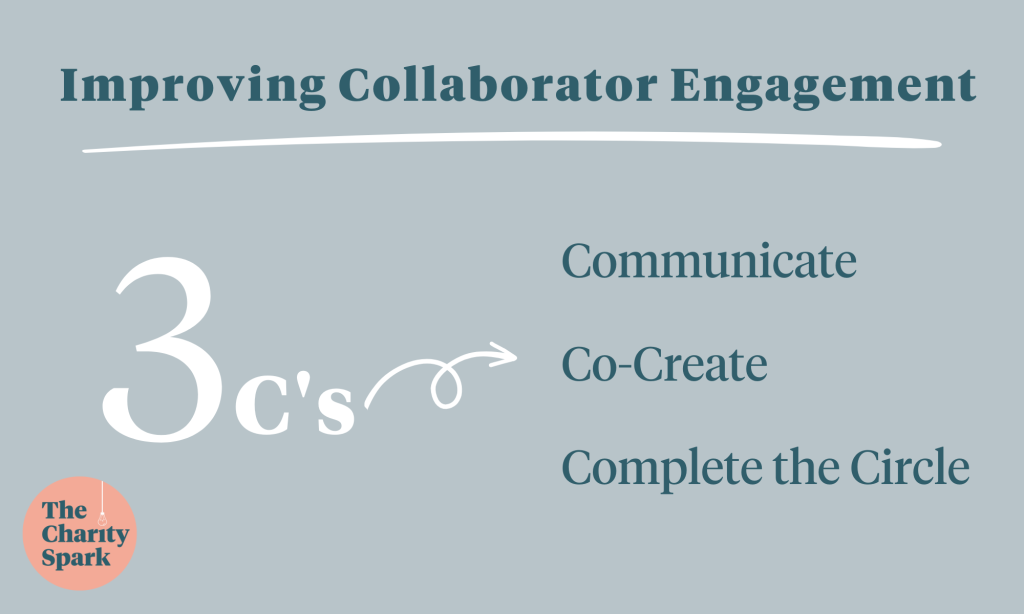
Improving collaborator buy-in and engagement:
Communicate: work with the people you want invovled to ensure everyone is clear on why the evaluation is important and why you are working on it, talk through the aims and the benefits of completing this work. Give people a chance to ask questions and have a discussion if necessary. Be transparent and honest in the information you give and remind people that all answers will be confidential.
Co-create: Ensure your evaluation is community-centred, talk to beneficiaries in an honest and accessible manner and without patronising. Importantly, listen to people. Take the time to really listen, hear what people have to say. If people feel listened to, they are more likely to cooperate and help where they can, they will trust you. Co-creation also provides an important opportunity to develop evaluation tools with your intended audience, ask them if the language is familiar, if the questions feel proportionate. Adapt and amend to reflect the feedback you’re given.
Complete the circle: What happened last time you evaluated a project? Who did you share the results with? Many of us get stuck in the process of completing an evaluation, sharing the results internally and with the funders of the work and then moving onto the next job. Sharing your evaluation (warts and all!) with those who you spoke to, with those the project involved and with those you are trying to reach, will help you to prove that you do something with the data gathered. Showing you are proactive, that opinions and experiences not only are heard but acted upon, is one of the most powerful ways you can improve collaborator buy-in for future evaluations.
We’d love to know what you have found works brilliantly in your own practice, how have you gained buy-in when you felt disengagement was a problem?
Share with us today!
