

We get it, fundraising can be scary, it’s overwhelming, sometimes thankless and often disheartening.
But it can be different.
Our Senior Fundraising Consultant, Emily Gandy, has outlined the best way to build your fundraising strategy is 5 clear steps.
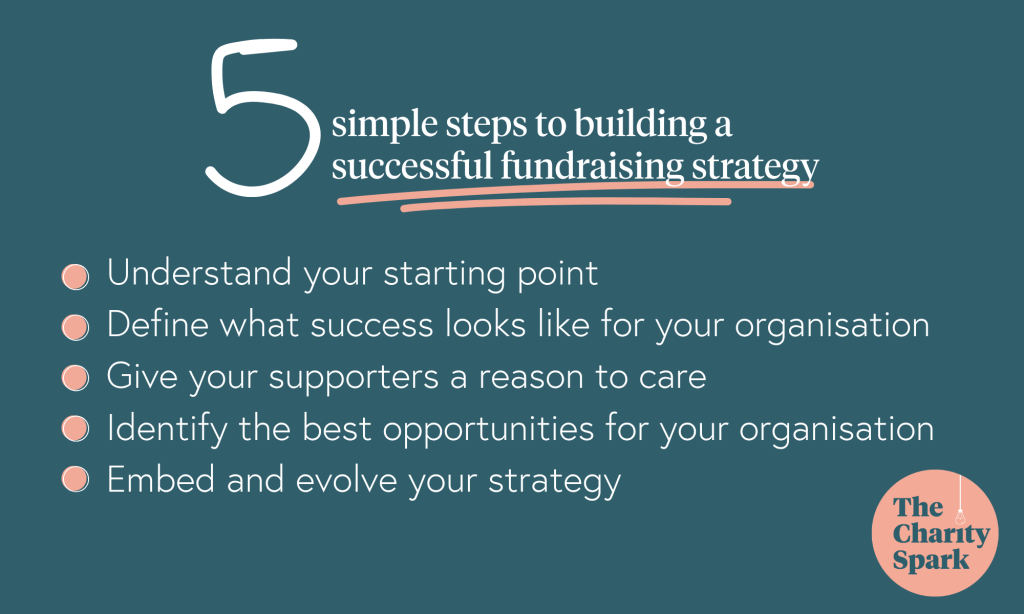
- Understand your starting point
You can’t write an effective fundraising strategy unless you know where you’re coming from and what you’re trying to improve upon. Take some time to review your current fundraising performance and income streams, assess your organisation’s internal strengths and weaknesses and identify external opportunities and challenges. What’s working well and what’s not?
Spend some time analysing your organisation, your fundraising activity and your community. We recommend conducting a SWOT (strengths, weaknesses, opportunities and threats) analysis and use a PESTLE (political, economic, social, technological, legal and environmental) analysis alongside it to better understand any wider environmental factors that might affect your organisation and fundraising activity Consider your team’s capacity, your available resources and systems you use (such as your CRM or other planning resources). Don’t forget to also identify key risks and dependencies that need to be considered.
- Define what success looks like for your organisation
What’s the dream? Where do you want your organisation to be?
Emily recommends aligning your fundraising objectives with your organisational priorities. Set realistic income targets that reflect your short and long-term ambitions. Define how you plan to measure success, think about how you will evaluate your fundraising and use SMART (specific, measurable, achievable, relevant and time-bound) objectives where appropriate.
Be ambitious, but evidence your ambitions. A fundraising strategy should reflect your current resources and the additional investment or capacity that may be needed to achieve future growth. Rather than being constrained by today’s limitations, use the strategy to identify and justify the resources required to reach your goals.
The most successful fundraising strategies don’t just plan for growth; they create the conditions for it.
Think outside the box. You never know what’s out there!
- Give your supporters a reason to care
People won’t support your cause simply because it exists. They need to understand the problem you’re addressing, the change you’re trying to create, and the role they can play in making that change happen.
Clearly articulate the need your organisation exists to meet and paint a compelling picture of the future you’re working towards. What difference will a donation make? What can you achieve with additional funding that wouldn’t otherwise be possible? Just as importantly, explain why your organisation is uniquely placed to deliver that change. You’re the experts, so don’t be afraid to demonstrate your knowledge, experience and impact.
Different audiences will respond to different messages, so take time to understand who you’re speaking to. The content that works well on social media may not be the most effective approach for a grant funder, corporate partner or regular giver. Tailor your communications accordingly, while ensuring your core message remains consistent.
A strong case for support brings all of this together. By combining real-life stories and case studies with evidence, outcomes and beneficiary feedback, you can create a compelling reason for people to invest in your work. Read more in our previous blogs: Creating a Compelling Case for Support and Using Your Case for Support to Apply for Funding.
- Identify the best opportunities for your organisation
Think about how you will generate income, and which income streams are most appropriate for your organisation. There are different ways to do this and different funding streams to consider such as trust and foundations, corporate partnerships, major donors, individual giving and events and community fundraising.
It’s important to build a balanced and sustainable income portfolio. Having multiple sources of income provides greater resilience and protection if one of those sources becomes less fruitful. Make sure your plan is future-proof and can adapt to changing circumstances. At this stage you should prioritise activities with the greatest potential impact, balancing quick, easy wins with sources that may be harder to access but have the potential to deliver greater returns.
Balance out short-term opportunities with long-term sustainability. Your strategy wants to be able to last. Your strategy should not only meet your immediate income needs but also support your organisation’s future growth.

- Embed and evolve your strategy (don’t let it stand still)
It’s time to think about how you will deliver your strategy and ensure it continues to evolve to reflect changing circumstances and future priorities.
Create a practical activity plan and timeline and allocate responsibilities and budgets to the best projects and people. Make sure the plan is reviewed regularly to keep your organisation on track. Establish a routine of reviewing and reporting on your processes to help you measure performance. This is a great way to show funders how you are using their money and how it is having an impact on your projects and the community you exist to help.
Take the time to track supporter engagement as well as income. Some campaigns may generate great engagement but less income than expected, while others may perform well in both engagement and income generation. Identify what works and what doesn’t and continue to adapt and refine your strategy to reflect these results and learning.
The most effective fundraising strategies start with a clear understanding of where you are today, where you want to be, and the actions needed to get there.
For help and support with your fundraising strategy get in touch today hello@thecharityspark.co.uk
