

Budgeting for anything extra can seem scary for a charity, especially a small charity with limited funds. An external evaluation budget is an important process if you are going to get the right organisation in to support you whilst also being mindful of your own financial constraints.
Evaluation of your projects is something that is so important and can help hugely long-term in applying for more funds or grants. Being able to prove that you do what you say you do is an vital part of the charity life-cycle, you can read more about this in our previous blog; Understanding the Charity Life-Cycle: How you can do more good daily.
In this blog, we have taken a slightly different take on the question ‘how much does an evaluation cost?’ – we wanted to share how we develop a quote for an evaluation when a charity comes to us for help to give you an overview on how you can think about your budget before approaching an evaluation.
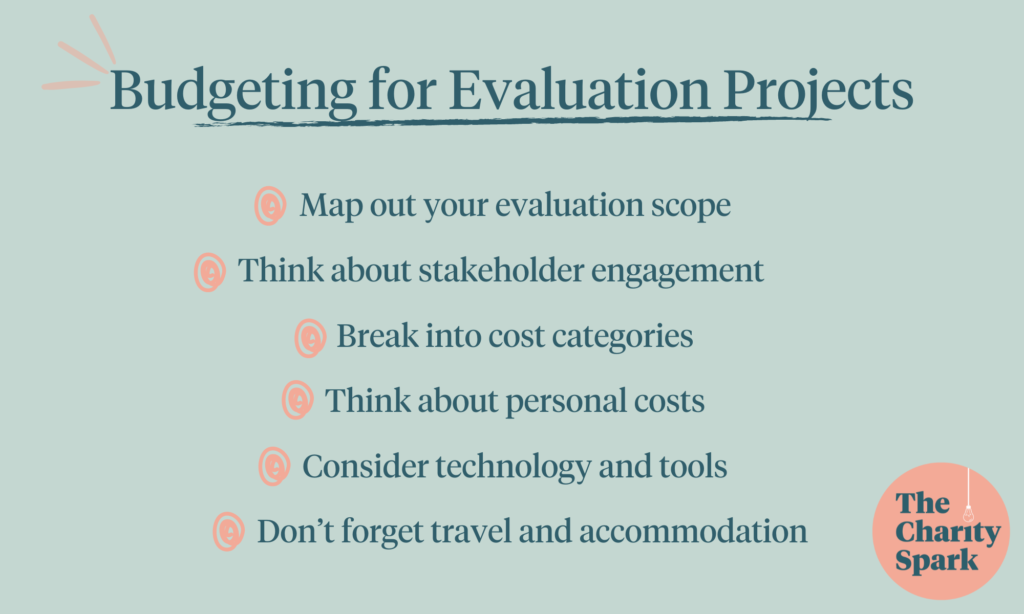
- Do you, the client, have the scope of the evaluation mapped out? What do you want included? What don’t you need? When we first meet to chat with you about your evaluation needs as an organisation, we will first be aiming to find out what the purpose and objectives of the external evaluation are: is this for your own organisations information and development? or is it to pass on to previous funders and grant-givers to show what you’ve been able to do with the help of their financial contribution? We also need to identify key areas to be assessed and evaluated and to consider the scope of the evaluation in terms of time and resources.
- Stakeholder Engagement. Your stakeholders (that is, anyone that is involved in, or has an interest in your activities or projects) are an important part of the evaluation process, we need to know if they will be taking an active part in the process. We will be asking you to list all relevant stakeholders and consider whether they will provide support to engage the stakeholders. This is often easier done by you, the client, as you already have a working relationship with them. Equally, it’s important to know if you have gained input from programme managers and staff who will be involved. The whole process of evaluation will run a lot more smoothly if everyone is on board and understand the importance of it. We will also be looking to ensure alignment of our expectations and goals – how thorough is the brief? Do we need to ask more questions?
- Cost Categories. To make things easier, clearer, and more accurate, we break our costs down into categories such as staff time (days), travel and overnight stay expenses, tools (e.g. digital survey, transcription), accessibility (we always build a fund in to pay for participant time and expenses, interpreters etc) and subcontractors (designer, proof-reader, or other specialists outside of our skill set). We also allocate a specific budget for each part of the evaluation to maintain transparency so you can see exactly where your money is going and why. VAT is included in our budget as it is something that we legally have to charge.
- Personnel Costs. When we are planning which of our team members will be involved in an evaluation project, we outline the roles and responsibilities of each of them. This makes it clear to you as to why each member is involved and what the importance is of this – we all have different expertise! Our day rates start at £400/day +VAT but do depend on the scope of the project, the time required and the expertise needed. It’s also important for you to consider the time commitment of your internal supporting staff and allocate resources accordingly for each person.

- Technology and Tools. In our budgets we consider any necessary evaluation tools and technology ensuring to include this in our proposal. We consider costs associated with data collection, analysis software, and reporting tools, all of which are an important part of being able to produce a good end product for you. At The Charity Spark, we explore cost-effective options without compromising quality, we know that often your budgets are tight, and we want to be able to honour that while still producing the best evaluation for you that we can.
- Travel and Accommodation. There will inevitably, always be some need for travel and accommodation for our staff while working on evaluation projects to carry out on-site visits or meetings. This is something that we consider when planning our budgets. We estimate travel expenses for our evaluators, including transportation and lodging while also exploring any opportunities to reduce this by meeting virtually where possible.
- Materials and Resources. Our budgets include any materials or resources needed for data collection and analysis, this includes costs for surveys, interviews, or other evaluation methods. We also consider the outputs such as fully designed ready to publish PDFs, which will cost a very different amount to commissioning full impact videos for example. This is something we will discuss with our clients to see what sort of output they are expecting.
- Timeline Considerations. We always aim to create realistic timelines for the whole evaluation process, including factoring in any potential delays and adjustments that may occur. To do this, we allocate budget resources based on different phases of the evaluation.

What can the client do to help?
- Be prepared to negotiate. If you come to us with a specific budget in mind, we will give you an idea of what we can do for that figure including expenses and VAT. If you don’t have a clue where to start with a budget then we will ask you some questions about your evaluation needs, read through your brief and then build a quote using the steps above. It will then give us something to discuss – if we need to come down in price then we can work with you to identify elements which can be left out for now or discuss ways that some of the work can be done in house to reduce consultancy days.
- Be realistic – consultancy day rates are higher than in-house staff day rates. You are paying us for experience gained over decades of experience and numerous projects working with charities just like yours. In return we will be flexible, supportive, add as much value as we can and meet your deadlines.
- Have a contingency plan:
- Set aside a portion of the budget for unforeseen expenses
- Anticipate changes in the evaluation process and plan accordingly
- Be flexible and ready to adapt the budget as the evaluation progresses
We rarely ask for more money! We usually work to a fixed pre-agreed cost. That being said, if you add components or change the scope significantly then there will be an impact and we will discuss this with you before committing to anything. We always aim to be transparent in our costs and our projects.
How can we help to keep the costs down? We always aim to keep our costs to a budget that suites each individual organisation and there are sometimes ways that you can help us with that.
- Consider what support can be provided in house. For example, can you coordinate workshops, meetings and support in engaging stakeholders?
- How much needs to be in-person vs could be done online?
- Do you have in-house designers? Or a volunteering budget which could cover the accessibility needs?
- Consider a staged approach to the evaluation or splitting it over more than one financial year. We are always happy to be flexible with timings for projects.
When you see the number of elements which need to be considered when commissioning an external evaluation, you can see why well-planned project, and budget, is essential in ensuring a successful external evaluation.
We work really hard to keep our costs fair and transparent, we know that charity budgets are stretched. However we also know the value of a really well thought through evaluation and so will ensure that we keep things as cost-effective as possible whilst not reducing the flexibility, efficacy and value of the overall research.
Do get in touch with us if you’d like to talk more about a research evaluation you’d like to undertake, we’d be delighted to help.
