

We can probably all agree that collecting evidence of your organisation’s impact important and that the data you collect can help strengthen your charity’s communication, programme development and fundraising. But what’s a good way to assemble and publish that data? At The Charity Spark we highly recommend gathering your data into an impact dashboard.
As a charity you collect your impact data. This data is analysed and the findings are put into an engaging visual dashboard: think graphs, images and infographics. This is then developed into a display of outputs and outcomes (check out the difference here: Confused about outputs vs outcomes? Here’s what you need to know) that can be shared with your collaborators, community partners and beneficiaries as well as potential funders.
Part one of this blog series will walk you through the benefits of having a good quality, dashboard. In this first part, we’ll explore why dashboards matter and how they can transform your impact reporting.

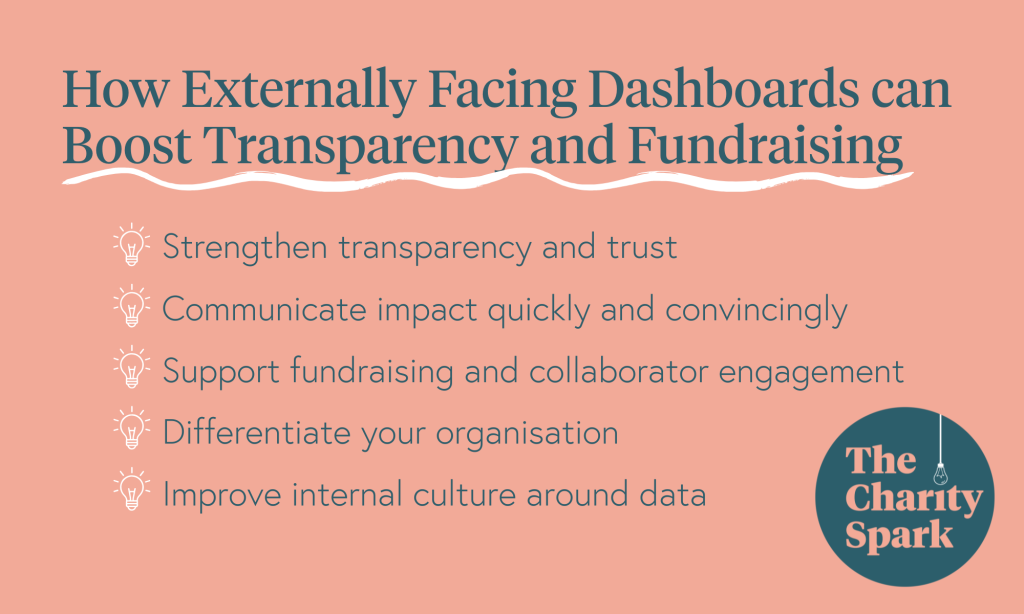
- Strengthen transparency and trust – A dashboard can be great for demonstrating accountability to funders, beneficiaries, and partners of organisations. It can be used to show openness about what is working, what is still in progress and any challenges that you might have faced, as well as showing how resources are being used.
- Communicate impact quickly and convincingly – Visuals are such a useful tool, they’re accessible and quick and easy to read. Your dashboard can help you to turn complex data into more accessible formats allowing different audiences to grasp key achievements at a glance and providing a consistent narrative about organisational impact without complicated data.
- Support fundraising and collaborator engagement – Sometimes it can be hard to get your collaborators and interested partners engaged in your work or onboard with your latest vision. Having a dynamic visual dashboard can offer funders real-time (or regularly updated) insights that keep them up to date and in the loop. Being able to showcase the progress you are making will in turn increase the likelihood of future investments. Supporters and collaborators love to see tangible outcomes from their contributions, whether financial or practical.
- Differentiate your organisation – It’s so important to be able to stand out from the crowd when applying for funding, it’s competitive out there. Having readily accessible, transparent and current data can position your organisation as being data-mature and impact-driven. This helps position your organisation as one who uses evidence-based decision-making and who can prove the need and impact of their work.
- Improve internal culture around data – Data can feel scary if you’re not an evaluator or used to working with it. It can feel overwhelming to gather. Having a dashboard gives staff a shared reference point for progress and a clear objective for that data. It encourages a culture of reflection and learning, and aligns teams around key impact indicators.
Now is the perfect time to start planning your dashboard to present your outcomes and outputs data both internally and externally. Your impact dashboard can be a really powerful tool for transparency, engagement and credibility. All of which can help you to enhance your programmes, develop work to meet the need and to build successful fundraising campaigns.
Successful dashboards rely on strong foundations, clear data, thoughtful governance, and organisational readiness. Keep an eye on our website and socials for the second part of this blog: How to Assess Your Charity’s Readiness for an Impact Dashboard.
The Charity Spark would love to work with your organisation to help you evaluate your projects. Contact us today to learn more about how to gather and organise your impact data in preparation for developing your own brilliant impact dashboard.
If you want to have a go yourself, then take a look at Raiser which our Director, Beckie, has co-founded. It is a brilliant new platform which is helping charities develop their impact story and, in turn, their fundraising. Using the tools within Raiser, you can narrate, build and publish your own Impact Story Board.
