
The Charity Life Cycle is something we talk about frequently at The Charity Spark, using it to explain to our clients why insight-led strategy is so important and how it can create a sustainable future. The cycle is an admittedly fairly blunt, un-nuanced way to describe how charities work, but it is effective in its simplicity. It is a helpful tool to link together essential parts of the work of a charity. Each stage is important, and each stage leads on to the next one.
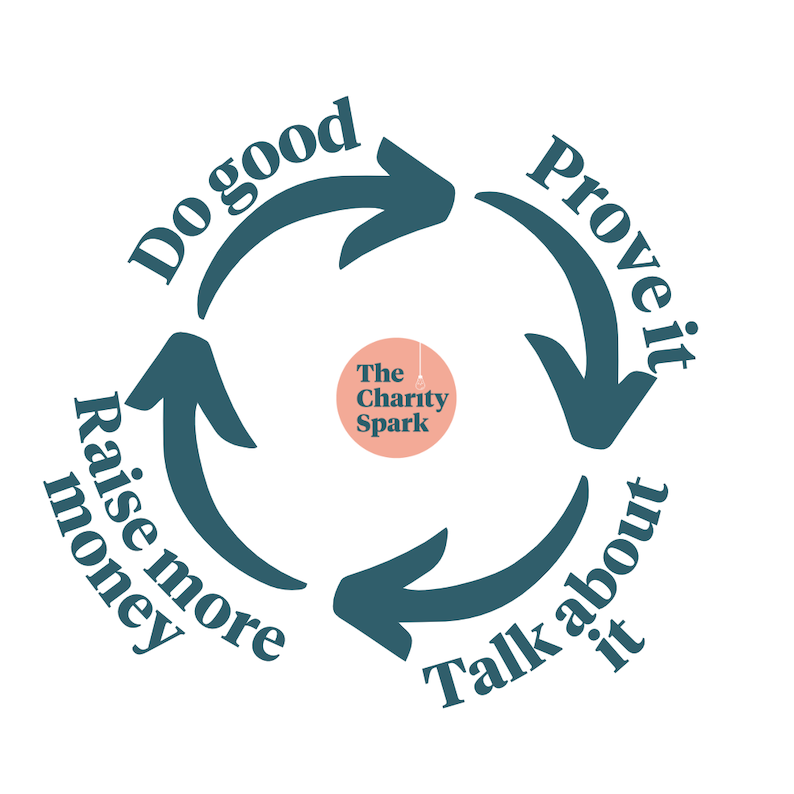
We know that charities exist because they can see a problem and want to do good on a daily basis. They know there is need and they have an idea of how to help. The charities develop programmes, services and activities that can meet that need. Somehow, they raise money, gather volunteers, equipment, resources, and they get to work. Through this they begin to see change happening for individuals, communities, or wider society.
Over time, charities find they need to prove that they do what they say they do. It’s an important step that is often forgotten about or put onto the ‘let’s cross that bridge when we come to it’ list. This important step of evaluation and impact measurement helps the charity to demonstrate that their programme, activities or support system is doing what they expected it to do, that it is creating change and helping to meet the societal need. The charity can use this impact insight to help refine their work to create greater impact and, importantly, build a sustainable future.

The question of what to do with this acquired knowledge and insight is an important one. We don’t purport to be communications specialists but we do know it is important to share what we learn with those that care about the work of the charity: with the people or group of people they exist to support, with your donors, with policy makers, with partner organisations and with people who are interested in what you are doing but not yet on a journey of support.
Of course, you want to continue doing more good daily, and to do that you need funding. Being able to use the findings from your evaluatory work helps to demonstrate to funders that their donation will make a difference, it connects donors to the heart of the charity, and it allows you to clearly communicate the need you are serving on a daily basis.
And then the cycle begins again. If you are able to do more good daily, prove you can do what you say you can, talk about your work and raise more money, then you can do more good daily…and so it continues.
At The Charity Spark we support charities to prove they do what they say they do, to refine their programmes and to use this insight to generate more income. We help charities to create an effective life cycle and enable them to build sustainable futures.

Our work with STEM Learning
A great example of when we have been able to help a charity prove they do what they say they do and use it to secure further programme funding so they can do more good, is our work with STEM Learning. The Charity Spark were commissioned to evaluate their intensive STEM summer camp programme throughout its first year. Our evaluation helped STEM Learning evidence that the programme works well (our research found that young people attending the intensive STEM summer camps who were taking double science at GCSE achieve a whole grade higher than their peers who did not attend the summer camp), it provided them with opportunity to refine elements that weren’t as effective as they could be and our report was used to secure further funding from the original funder as well as new partners. Our report was also used to demonstrate how effective intensive interventions can be, at an APPG (All Party Parliamentary Group). STEM Learning are now able to use the further funding they secured to run more programmes. Read more here.
