

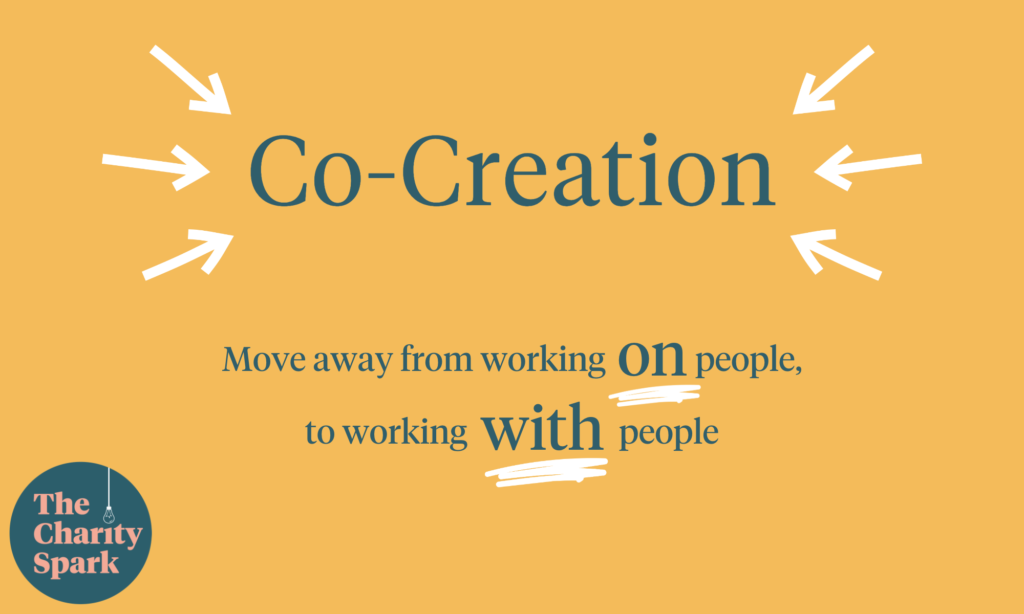
At The Charity Spark we believe co-creation is a very important part of our evaluation work. It changes the evaluation process from one of data extraction to one focused on shared learning and provides an equal approach to evaluation rather than ‘people with clipboards’ vs ‘people in need’. When adopted well, it means we, as charities, move away from working ON people to working WITH people. Co-creation is cropping up in programme development, evaluation and in community engagement. The Co-Creating Change Network describes co-creation as:
“…a co-operative process in which people with diverse experiences, skills and knowledge come together and work in non-hierarchical ways to address a common issue, and which enables people and communities to be actively involved in shaping the things which impact their lives. It shifts power, resource and ownership towards the people the work is intended to benefit, as opposed to the traditional ‘top down’ approach. It encourages every individual to activate their creative potential and realise their own ability to make change.”
Co-creating Change Network
What is co-creation?
It has become a bit of a buzzword in recent years (and let’s be honest, we have enough of those flying around), so let’s take a closer look into what it is and what it means for your (and our!) evaluative practices.
Co-creation is a shared process and methodology which focuses on keeping the community at the centre, it enables us to keep our eyes on what the community wants or needs from a project and how best to implement that.
Pausing for a second, it is good to clarify what we mean when we say community. We define community as a group of people with shared characteristic(s). That could be that they share a geographical location or it may be that it is a community of people who identify in a certain way e.g. people with Down’s Syndrome living in West Sussex. As a charity, your community is likely to be the group of people who you exist to support. You may have more than one. We feel it is a much less jargon-y word than stakeholder group for example.
Co-creating programmes with embedded evaluation is a good way to stay transparent as a charity, to keep us fair and honest as we are continually held accountable to those communities that we are working with: inviting comments, questions and opinions from those who know the situation the best. Because we are consulting with the communities we want to support, we are reducing the risk of confirmation and/or unconscious biases that we may already be carrying with us or embedding into projects.
Co-creation can be easily scaled and applied to part or all of a project. Especially considering its evaluation, which is preferably viewed as a continuous part of the ongoing project, not as a standalone phase.
Okay, so how do I use co-creation?
Now that we’ve persuaded you that co-creation is an important and useful step, let’s think about how we use it and get the most out of it as an embedded part of your methodology.
You need to start by understanding who your community is, map out all the groups involved and identify how you can best involve them in this process. Typically we might say words like beneficiary, external stakeholders, internal stakeholders – we prefer community members. Work together to identify common aims and purposes for your projects and don’t set outcomes outside of the co-creation process as this can be undermining.
Think about what matters most to all involved? How can you capture that? You may need to add in extra steps to measure for accountability, for example, output measures such as how any people attended a course.
Involve people as early as possible, this helps communicate the original need as clearly as possible in language and terms which are important to those you are working with in your project.
You should also use co-creation to agree effective and proportionate methods of data generation and analysis. Work together to develop the ideas people have for what would and would not be an appropriate way to collect data – what your project team might want to collect may not align with what your community feel they can offer you which can tell you something about the key parts of your evaluation framework. Something that you may believe to be straight forward may not be appropriate or possible when you understand the nuances of the community with which you will be working. Take time to think about how you can use mixed-method approaches and develop tools like photo journals and surveys with your co-creation group.

Final steps of your evaluation
When reporting, it’s important to keep co-creation central by involving your community in looking at the findings, reflecting on what trends emerge and by providing feedback. This is essential in some processes such as most significant change where you work with a group to look for patterns and significant changes from their point of view. This is particularly helpful when new conclusions are proposed which reflect cultural significance that you may not be aware of as an evaluator.
Sharing your findings with those that created them is vital. Too often we forget to share reports within the community who were part of the project. Use this time to discuss what is next, ask the community to be involved with future planning and ideas, find out what still needs to be done from their point of view. Remember, reports should never be created solely for the funder. They are for you, the charity, to guide you in meeting the need of those you exist to support.
We would love to hear about your experience with co-creation, is it something you currently aim to use in your projects? Perhaps it’s something you’ll be using in the future. Do get in touch with us; hello@thecharityspark.co.uk
