

We’ve all noticed it, the price of everyday living is increasing: petrol, food, bills, rent, mortgages – everything seems to be affected. The country is deep into a cost-of-living crisis which has a huge impact for charities and the people they support. Many charities are wondering how they will keep their meeting an increased demand when so many people are struggling, and how, in turn, they can continue to fundraise so they can meet this need. The cost-of-living crisis is not only taking its toll on the people charities exist to support, but also on their own members of staff.
We see you.
We see that you’ve survived one crisis and global pandemic and you’re not emotionally or financially as strong as you have previously been. We can’t take away the worry completely, we can’t give you a magic answer but maybe we can give you some helpful information, advice and tips to enable you to keep up with fundraising and keep your charity afloat during this worldwide crisis.
So, what is the impact on charities and what do you need to think about, and prepare for, as costs continue to rise?
Most obviously more people may need your support, this will depend a little on what sector you are working in, but it will have very obvious impact on those working in the community and in welfare, resulting in increased need for your support which will increase your expenditure. If your charity doesn’t see a direct increase in demand for its services, you are likely to still see increased expenditure. These will include pay rises for your staff in line with the increased cost of living, as well as increased utility bills for your charity offices, cost of food (where relevant), cost of fuel and increased costs for other resources as we see suppliers put their prices up in response to their own expenditure increasing.
For some, the worry isn’t just about expenditure increasing but also income decreasing. Charities are not businesses and therefore cannot simply pass the increased costs onto a consumer. Things are more complicated than that in the not-for-profit sector. We need to begin to think more creatively to come up with a plan to get charities through these hard times.
Let’s look at how income can be impacted in more detail and how that might look for different income streams:
Firstly, individual giving. You may find that long term, regular supporters may have to reconsider their monthly giving commitments. Research by the Chartered Institute of Fundraising (CIOF) has reported that smaller donations are reducing in value and fewer are being made all together (https://ciof.org.uk/events-and-training/resources/how-giving-is-affected-by-the-cost-of-living-crisi). However, mid-range donations are staying the same or even increasing in some areas. We know we need to be prepared to see a drop-off in both regular donors and new donors. For those making the difficult decision to stop their regular support, make it easy for them to cancel and then give a meaningful ‘thank you’ for their commitments and giving so far. It isn’t all bad news, some people are looking for a way to support during this time, have you offered warm donors the opportunity to convert? Consider a thoughtful individual giving campaign centred on a specific need – not just a campaign based around the need for ‘x’ number of donors to be recruited to fill the gap in ‘y’ cancelling their regular gifts (yup, this REALLY came out from an international charity this week). Whatever you do, keep it rooted in beneficiary need and outcome!

You may also notice the economic crisis impact on events you plan. Selling tickets to fundraising events may become harder as these sorts of events may be a stretch too far for personal budgets. For mass participation events you may notice a reduction in ticket sales, reducing the ticket cost will make events more affordable. Similarly, event participants may be more reluctant to fundraise through sponsorship so this should be considered when setting event targets. Research has shown that there has been an upwards trend in major donor giving. For fundraising dinners and gala events; deliberately aiming to attract more high net worth individuals to the event, spending more personal stewardship time with donors; and enabling beneficiaries’ families to share their experiences of how donations helped them and their loved ones in an authentic way donors can relate to will all support greater levels of donations from these types of events.
Incomes from trusts and foundations is an interesting one during recessions. The competition of people applying for this sort of funding may intensify as charities pivot to diversify where they are seeking funding from, indeed we are already seeing the success rates of applying for a trust or foundation grant towards 1 in 10 rather than the 1 in 4 of a few years ago. However, depending on where a trusts own investments are placed (https://www.bestinvest.co.uk/news/the-cost-of-living-crisis-explained-how-is-it-impacting-your-investments), they may have more money to give as their investments see good returns. There is research to show that in a recession more people play national lotteries (https://www.gbgc.com/lotteries-luck-holds-during-recession/) which may increase the level of giving that the National Lottery funds have available to give. In the 2009 recession, the UK GDP fell by 4.8% whilst The National Lottery increased its revenue by 3.9%.
The fourth income stream we need to look at is major donors. So far in 2022 we have seen indications of an upwards trend in major donor giving. It seems that due to their great resources, wealthy people have more “confidence in their ability to maintain and extend their giving.” (https://www.beaconcollaborative.org.uk/high-net-worth-giving-continues-upward-trend-to-june-2022/). Due to this they are likely to “increase in both the number and size of gifts” in order to support the charities they connect with and care about during “periods of economic and political turbulence.”
Lastly, corporate giving. This is something that is variable as it is very much dependent on the corporate, their priorities, the sector they are in and their own financial position. Companies that are able to weather the storm will likely focus on existing charity partners as well as on supporting their own employees. Many will also reach out to the local community to support groups such as foodbanks, to see how they can offer support in their immediate area. For some it will be ‘business as usual’ including for their giving through charity of the year partnerships, foundations and employee giving. A few corporations and businesses will make money during the crisis and will be in a position to distribute that through a variety of channels.
What can you do as a charity or organisation to mitigate against the uncertainty and to find balance?
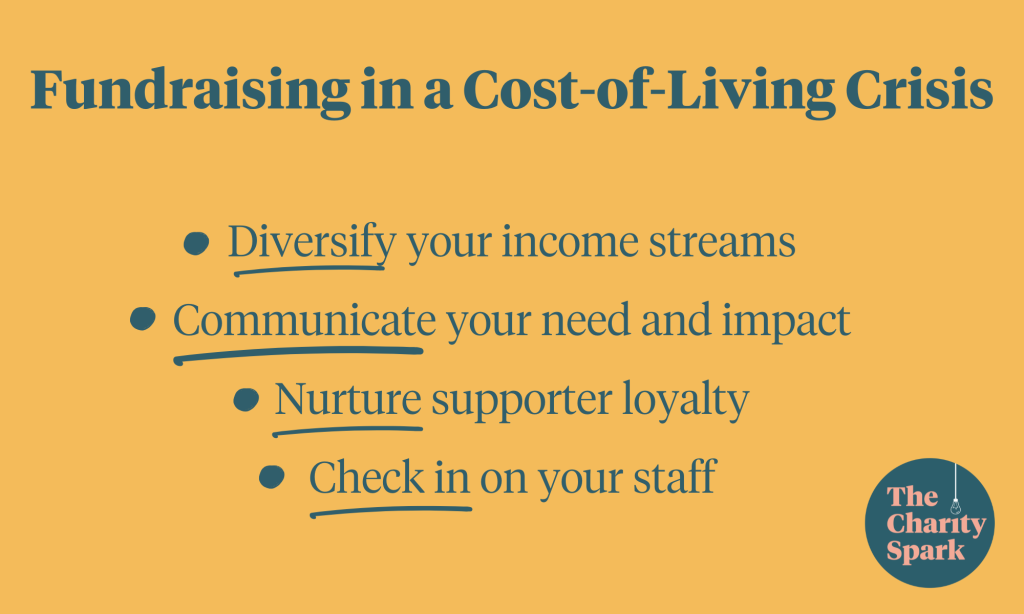
Diversify your income streams. If you only have one or two income streams, consider where you can diversify your income to try and spread the risk of another area decreasing. But you need to tailor your strategy – there is no ‘one-size-fits-all’ answer here. What are your strengths and weaknesses? What does your data tell you about your donors and funders? Do your research into other income sources and see what would fit you best.
Make sure you communicate your need and your impact – don’t be afraid of telling your donors that funds are stretched, and you are looking for extra support, but don’t put pressure on them to increase their giving if it’s not something they can do at the moment. It is so important to provide positive messaging about the difference a donation can make rather than focusing on the negativity of the crisis and sending messages that can results in a donor’s feeling obliged or guilty. Always ask the question ‘would I feel comfortable if I were being approached this way?’. ‘Are we asking at a reasonable level?” and ‘are we offering a variety of ways someone can support beyond financial giving?’ We must make sure our tone of voice is understanding and compassionate. Do you tell your
How often do you tell your donors the impact their support is making on your charity? Try to keep in touch with all sections of your supporter base and show them directly how their support, existing and historic, has made a difference so far to the work you do.
Focus on nurturing supporter loyalty. Your supporters’ journeys will be even more important than before. You need to think about how you are building loyalty within your supporter base and increase the ways you ask for support. Do you know what your supporters are thinking? Do you keep them up to date in a sensitive but timely way? Do they have control over their own communication preferences? These are all ways that can make a supporter feel values and appreciated. If your donor acquisition strategy is expensive, then it may be worthwhile considering whether time and investment into nurturing existing donors may return increased loyalty and potentially new or higher donations and in turn reduce your spending on finding new donors. Take time to consider who you are sharing your messaging with – existing corporate partners as well as those who have supported you before for example.
Check in on your staff. It’s worth spending some time focusing on your staff wellbeing. The charity sector is an exciting but intense place to work. From fundraisers facing a stressful funding landscape to project staff finding that people need more support than ever before, it’s going to be a tiring winter for all of us. They may also be worried about their own financial security. Do what you can to ensure staff wellbeing, considering increasing salaries where possible and making reasonable adjustments to support staff on a daily basis. Don’t forget your volunteers, ensure expenses are paid in a timely manner and understand if giving time becomes more difficult for some volunteers.
We’re all in this together. The following months will be a challenge for so many. But we can begin to think outside the box and find new ways to fund projects or get support for our charities.
Do get in touch with us if you need more support or advice hello@thecharityspark.co.uk or visit our website www.thecharityspark.co.uk
